Saturday, January 9, 2016

5 Traditional Sarees of Kolkata

5 Traditional Sarees of Kolkata:-

  1. Tussar silks
  2. Baluchari Saris
  3. Murshidabad Silk Saris
  4. Dhakai Jamdani
  5. Taant


Friday, January 8, 2016

Famous Bhagalpuri Silk Saree

Bhagalpuri silk or Tussar silk is a dying style of silk sarees and other clothes from Bhagalpur, Bihar in India. This material is used for making sarees named as Bhagalpuri Sari.


Thursday, January 7, 2016

Beautiful Design Handmade Jewelry

Types of  Handmade Jewelry:-
  1. Beaded Jewelry - Handmade jewelry often with a vintage touch, beads are weaved into a chain and made to give a lovely appearance. 
  2. Terracotta Jewelry - Terracotta is bakes earth or clay turned to different items such as pottery, sculptures, show pieces and also jewelry items.
  3. Tribal Jewelry - Tribal accessories are age old love of women much for their natural making with most common items found around you.
  4. Sandalwood Jewelry - Wooden jewelry that comes at a price and available in yellow and matte shade. Sandal beads have some religious and also medicinal implications. 
  5. Shell Jewelry - Shells found on the sea beaches are a great jewelry form now. Shops in Goa, Tamil Nadu and Orissa sell a number of shell items including elegant neckpieces, earrings and bracelets. 
  6. Pearl Jewelry - Round and smooth pearl beads available in black, white and pink shades make for elegant neckpieces, rings, earrings and bracelets. 
  7. Diamond Jewelry - Precious stone jewelry mostly brought on weddings and engagement. Diamond market is a vibrant one in Indian states of Kerala, Tamil Nadu and Maharashtra. 
  8. Silver Jewelry - The white polished jewelry that is less expensive than gold in rate, silver anklets, rings and even earthenware of silver and popular buys in Indian household.
  9. Gold Jewelry - Most Indian weddings, engagements and religious ceremonies are incomplete without gold jewelry. 
  10. Platinum Jewelry - The upcoming set of fine jewelry item that reflects class and more expensive than gold. 

Saturday, January 2, 2016

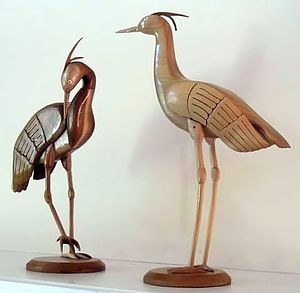
Wood Carving Handicraft Product

Wood carving is a form of working wood by means of a hurtful tool (knife) in one hand or a chisel by two hands or with one hand on a chisel and one hand on a hammer, resulting in a wooden figure or figurine, or in the sculptural ornamentation of a wooden object. 

The phrase may also refer to the finished product, from individual sculptures to hand-worked mouldings composing part of a tracery. 

The making of carving in wood has been extremely widely practiced but survives much less well than the other main materials such as stone and bronze, as it is vulnerable to decay, insect damage, and fire. 


It therefore forms an important hidden element in the art history of many cultures. Outdoor wood sculptures do not last long in most parts of the world, so that we have little idea how the totem pole tradition developed.

Many of the most important sculptures of China and Japan in particular are in wood, and the great majority of African sculpture and that of Oceania and other regions. 

Wood is light and can take very fine detail so it is highly suitable for masks and other sculpture intended to be worn or carried. It is also much easier to work than stone.

Wednesday, December 30, 2015

Puri Stone carving

Stone carving is an early activity where pieces of rough natural stone are shaped by the controlled removal of stone. Owing to the stability of the material, stone work has survived which was created during our prehistory.
Work carried out by paleolithic societies to create flint tools is more often referred to as knapping. 

Stone carving that is done to produce lettering is more often referred to as lettering. The process of removing stone from the earth is called mining or quarrying.


The term Stone carving is one of the processes which may be used by an artist when creating a sculpture. The term also refers to the activity of masons in dressing stone blocks for use in architecture, building or civil engineering. 

It is also a phrase used by archaeologists, historians, and anthropologists to describe the activity involved in making some types of petroglyphs.

Thursday, December 17, 2015

Famous Ganjam district Sonepuri Sari or Bomkai Sari

Sonepuri Sari or Bomkai Sari is produced by the “Bhulia” community of Subarnapur district of Odisha, India. In particular, the famous sari designs Bomkai are the traditional designs that was produced in the village named Bomkai of Ganjam district of Orissa. 

During the time of Ramai Dev the then ruler of Patna it was introduced in Sonepur.Sonepur handloom sarees, Sonepuri paatas and silk sarees are popular items displayed at various fashion shows.

Image Credit:-serifed